 ultimate-guide
Average Locksmith Response Time at 2 AM: What to Expect
Table of Contents
- What the Average Locksmith Response Time at 2 AM Actually Looks Like
- Factors Affecting Locksmith Response Time at Night
- Emergency Lockout Service Cost: What Changes After Midnight
- How to Find a Reliable 24-Hour Locksmith Before You Need One
- Safety Protocols for 2 AM Lockouts and What to Expect on Arrival
- Emergency vs. Non-Emergency Service: Knowing the Difference
- Frequently Asked Questions
Last Updated: September 28, 2026
What the Average Locksmith Response Time at 2 AM Actually Looks Like
If you're locked out at 2 AM, the average locksmith response time at 2 AM typically falls between 30 and 60 minutes in a dense metro area, and 60 to 90 minutes or longer in rural zones. That range assumes a mobile locksmith is genuinely on call and reasonably close. It is not a guarantee, and any dispatcher who promises a flat number before checking technician location is guessing.
Typical Arrival Windows for Emergency Calls
Most emergency dispatch windows break down into three tiers:
- Urban core, technician nearby: 20 to 40 minutes
- Suburban ring, moderate distance: 40 to 70 minutes
- Rural or low-density service area: 60 to 120 minutes
These are arrival windows, not dispatch times. The clock that matters is when a technician pulls up, not when a call center answers.
Why 2 AM Calls Differ From Daytime Service Calls
Daytime service calls draw on a full roster. At 2 AM, you're working with whoever is on the night shift, and that pool is smaller by design. Fewer technicians, longer travel distances, and fewer nearby options all stretch the ETA. The Federal Trade Commission's consumer guidance on service scams is worth reading before you ever need it, because it explains how to spot a dispatcher who is farming your call out to the lowest bidder.
Factors Affecting Locksmith Response Time at Night
Several variables decide whether you wait 25 minutes or two hours. Understanding them helps you set realistic expectations and choose a provider who can actually deliver.
Traffic Conditions, Urban Density, and Geographic Radius
At 2 AM, traffic is rarely the bottleneck. Distance is. A technician 15 miles away on an empty highway arrives faster than one 4 miles away navigating a dense grid of one-way streets. Urban density cuts both ways: more technicians per square mile, but also more complex routing.
On-Call Technician Availability and Peak Demand
Peak demand for after-hours service clusters around bar closing times, holiday weekends, and the first cold snap of the season. When several lockout calls hit the same dispatch board at once, the later callers wait. A mobile locksmith operation with more on-call technicians can absorb that spike better than a one-van shop.
Emergency Lockout Service Cost: What Changes After Midnight
Emergency lockout service cost rises after midnight because you're paying for availability, not just labor. The technician who answers at 2 AM is giving up sleep and working outside standard business hours, and that premium shows up on the invoice.
After-Hours Surcharges and Service Fees Explained
A typical night call breaks into three parts:
| Charge Type | What It Covers | When It Applies |
|---|---|---|
| Service call fee | Dispatch and travel to your location | Every after-hours call |
| After-hours surcharge | Premium for overnight availability | Calls outside business hours |
| Labor and parts | Lock manipulation, key extraction, hardware | Based on the actual job |
The mistake most people make is comparing only the quoted service fee. A low service fee paired with a steep surcharge can cost more than a higher flat rate. Ask for the total before the technician is dispatched, and get it confirmed in writing or by text.
How to Find a Reliable 24-Hour Locksmith Before You Need One
Finding a reliable 24-hour locksmith is a daytime task, not a 2 AM one. The worst time to vet a provider is when you're standing outside your own front door in the cold.
Do the research now and save the number:
- Confirm the business has a physical local address, not just a call center
- Check that the company name matches on the website, the phone listing, and the invoice
- Ask whether technicians are employees or subcontractors
- Request the total price structure for after-hours calls before you need one
- Save the number in your phone under a name you'll recognize at 2 AM
Verifying Credentials and Avoiding Scam Operators
Locksmith verification comes down to three checks: a verifiable license or certification, proof of insurance, and a consistent local identity. Scam operators often operate through lead-generation call centers that route your call to whoever answers, then quote a low number and inflate it on arrival.
Safety Protocols for 2 AM Lockouts and What to Expect on Arrival
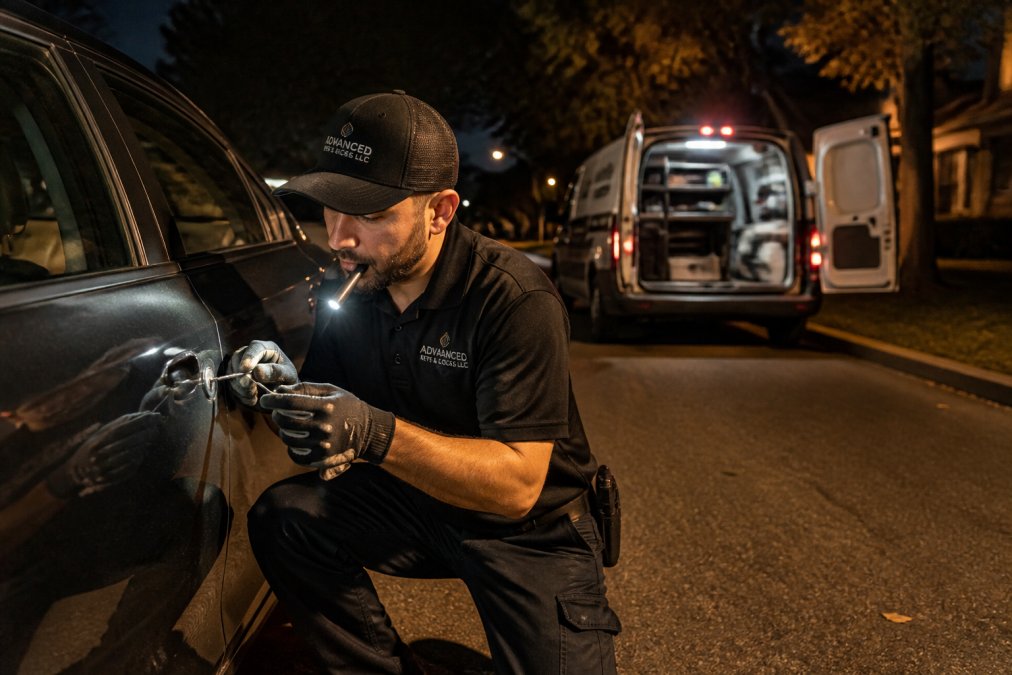
Safety protocols for a 2 AM lockout start before the technician arrives, and they matter more at that hour than at any other. Most guides treat this as a footnote. It is not. At 2 AM you are standing outside in the dark, often alone, sometimes in an unfamiliar neighborhood, and the person you are about to let near your home or vehicle is a stranger.
A Waiting Checklist for Dark or Isolated Locations
Run through this in order the moment you realize you are locked out:
- Move to the safest visible spot. A 24-hour gas station, a hotel lobby, or a well-lit storefront beats standing on your own porch if the street is empty. If nothing is open, stay under the brightest light you can find and keep your back to a wall, not to the open street.
- Tell someone where you are. Send a trusted contact your live location, the name of the locksmith company you called, and the estimated arrival window. If your phone supports it, share your location for the next hour rather than a single pin.
- Keep your phone charged and in your hand. Do not bury it in a bag. If you are in a vehicle, keep the doors locked and the engine off unless you need heat or AC.
- Do not accept unsolicited help. A stranger who offers to "pop the lock" for cash at 2 AM is not a locksmith. Decline, stay visible, and wait for the company you actually called.
- Have a fallback. If the ETA passes by 20 to 30 minutes with no update, call the dispatcher back. If you cannot reach a human, call a second company. Do not wait indefinitely in an unsafe spot out of politeness.
Verifying the Technician Before You Let Them Work
The single most valuable safety step at 2 AM is confirming the person who arrives is who they say they are. Locksmith fraud disproportionately targets after-hours callers, because that is when customers are least likely to comparison-shop and most likely to accept whatever price is quoted on the spot.
Before any work begins:
- Match the company name. The name on the technician's vehicle, uniform, or business card should match the company you called and the name on your phone's call log. A mismatch is a red flag.
- Ask for identification and a license or certification. A legitimate technician expects this request and will not be offended by it. If they refuse or get defensive, do not let them start.
- Confirm the price again, in person. The total you were quoted on the phone should be the total you are asked to pay. Get it confirmed before the technician touches the lock.
- Watch for the drill-first pitch. A technician who immediately insists the only option is to drill and replace the entire lock, before examining it, is often running an upsell. Many standard residential and automotive lockouts can be opened with non-destructive manipulation or key extraction.
- Pay by card or traceable method when possible. Cash-only demands with no receipt make it nearly impossible to dispute a fraudulent charge later.
What a Legitimate Arrival Looks Like
When a professional technician arrives, expect a predictable sequence:
- They identify themselves and the company, and show credentials on request
- They confirm the quoted total before starting
- They assess the lock and explain the method they intend to use, manipulation, key extraction, or, only if necessary, drilling
- They complete the work, test the lock, and provide a receipt with the company name and total paid
A professional will never pressure you into a more expensive job than the lock requires, and will never ask you to pay before the work is done. If either happens, you are within your rights to stop the job and call someone else.
Emergency vs. Non-Emergency Service: Knowing the Difference
Emergency service means you cannot secure your property or access your vehicle, and waiting until morning is not safe or practical. Non-emergency service covers rekeying, lock replacement, master key systems, and security upgrades, all of which can be scheduled during normal business hours at lower rates. The distinction matters most at 2 AM, because that is when the after-hours surcharge is highest and when misclassifying a job costs you the most money.
A Quick Decision Framework
Ask yourself three questions before you dial:
- Can I secure the property or vehicle right now without help? If the answer is no, the door will not lock, the keys are inside, the car is running or unlocked, it is an emergency.
- Is waiting until morning safe? If you have no safe place to sleep, no way to secure valuables, or a child, pet, or medication locked inside, it is an emergency. If you can go to a hotel, a friend's place, or a secure location and return in the morning, it usually is not.
- Is anyone at risk? A lockout that leaves someone stranded in cold weather, in an unsafe area, or without access to necessary medication is an emergency regardless of the hour.
If you answered yes to any of those, call now. If you answered no to all three, wait until morning and save the surcharge.
Common 2 AM Emergencies
- Locked out of your home with no spare key and no safe place to wait
- Locked out of your car in a parking lot or on the street at night
- Keys locked inside a running vehicle
- A broken lock or key snapped in the cylinder that leaves the door unsecured
- A commercial storefront or office that cannot be locked after closing
Jobs That Can Wait Until Morning
- Rekeying a home after a move or a tenant turnover
- Replacing worn or outdated locks
- Installing a smart lock, deadbolt, or master key system
- Duplicating or programming spare keys
- Adding a safe, a lockbox, or a security upgrade
Treating a non-emergency as an emergency costs you the after-hours surcharge for no reason. A rekey that runs $80 to $150 during the day can cost noticeably more when it is dispatched at 2 AM, and the work itself is identical.
Frequently Asked Questions
How long does a locksmith usually take to arrive at 2 AM?
Most emergency locksmiths arrive within 30 to 60 minutes for a 2 AM call, though the average locksmith response time can stretch to 90 minutes in rural areas or during high-demand periods. Urban areas with higher technician density tend to see faster dispatch times. When you call, ask for a specific arrival window and confirm whether the technician is already on the road or still being dispatched.
Is there a price difference for emergency locksmith services at night?
Yes. Emergency lockout service cost typically includes an after-hours surcharge because the technician is working outside normal business hours. The service fee itself may also be higher for 2 AM calls than for a weekday afternoon job. Ask for a full quote before the technician is dispatched, and request confirmation that the quoted price covers the after-hours surcharge, mileage, and any lock manipulation or key extraction needed.
What factors influence locksmith response times at 2 AM?
The biggest factors affecting locksmith response time include technician location, traffic conditions, urban density versus rural response, and whether the locksmith has an on-call technician available or must wake someone up. Peak demand nights, like holidays or weekends, can also slow dispatch. A mobile locksmith already in your area will arrive faster than one driving across a large geographic radius.
What should I do while waiting for a locksmith at 2 AM?
Stay in a well-lit, safe location, ideally inside your vehicle or a nearby open business if you have a residential or auto lockout. Keep your phone charged and the line open in case the dispatcher calls with an updated ETA. Have your ID and proof of residency or vehicle ownership ready so the technician can verify you before performing lock manipulation or key extraction.