 how-to
Avoiding Hidden Locksmith Service Fees: 7 Smart Steps
Table of Contents
- What Are Hidden Locksmith Service Fees?
- Locksmith Service Call Fee Average: What to Expect
- Questions to Ask a Locksmith Before Hiring
- How to Spot a Locksmith Scam: Red Flags to Watch For
- Step-by-Step Guide to Avoiding Hidden Locksmith Service Fees
- Payment Trails and Dispute Resolution
- Vehicle Lockout Risks and Fees
- Conclusion: Your Action Plan for Transparent Locksmith Services
- Frequently Asked Questions
Last Updated: September 16, 2026
What Are Hidden Locksmith Service Fees?
Hidden locksmith service fees are charges added after a technician arrives that were never disclosed in the phone quote, drilling fees, after-hours surcharges, hardware markups, and mileage charges. Avoiding hidden locksmith service fees starts with knowing where they hide before you dial.
Locksmith Service Call Fee Average: What to Expect
A locksmith service call fee average covers the trip charge plus basic labor for standard entry. Most reputable providers separate this into a flat service call fee and an hourly labor rate, with a clearly stated after-hours surcharge for nights, weekends, and holidays.
- Service call fee: the base trip charge to get a technician to your location
- Labor costs: billed flat rate or hourly, depending on the company
- After-hours surcharge: typically applies outside standard business hours
- Hardware markup: the cost difference between wholesale and retail lock parts
Questions to Ask a Locksmith Before Hiring
The right questions to ask a locksmith before hiring expose whether the quote is real. Ask about total cost, credentials, and payment terms before giving your address.
Run through this list on every call:
- What is your total estimated cost, including the service call fee and labor?
- Are you licensed and insured, and can you provide your license number?
- Is there an after-hours surcharge, and how much is it?
- What is your physical business address?
- Will you provide a written estimate before starting work?
- What payment methods do you accept, and will I get an itemized invoice?
- How long until a technician arrives?
Phone Script for Pre-Booking Verification
Use this script to screen any locksmith before dispatch:
"Hi, I'm locked out and comparing quotes. Before I book, I need a few things confirmed: What's your total estimated cost for a standard residential lockout, including the service call fee? Is there an after-hours surcharge tonight? What's your license number and physical business address? Will I receive a written estimate before any work starts? And what payment methods do you accept?"
How to Spot a Locksmith Scam: Red Flags to Watch For
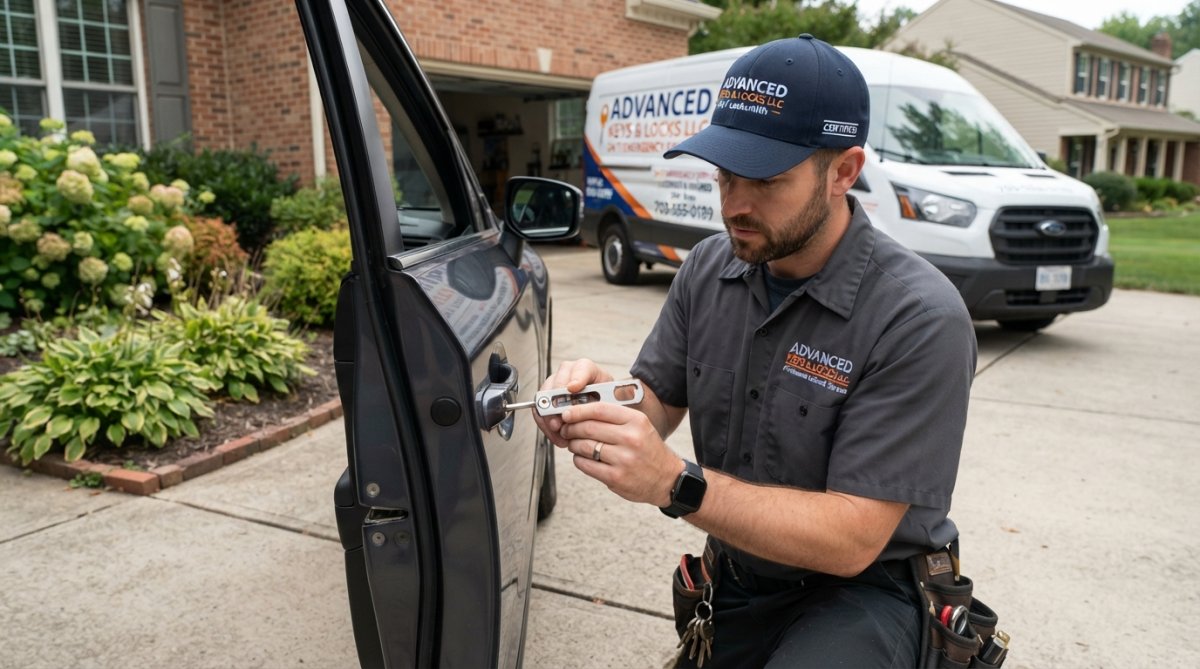
Knowing how to spot a locksmith scam protects you from the worst offenders. The clearest red flags: unmarked vehicles, no visible license, cash-only demands, and quotes that change once the technician sees your lock.
Watch for these warning signs:
- No physical address: the company operates from a call center, not a local shop
- Unmarked vehicle: legitimate providers usually drive branded vans with a business name
- No license or insurance proof: a certified locksmith carries credentials
- Cash-only demands: refusing cards leaves no payment trail
- Immediate drilling: a technician who drills first and asks questions later is padding the bill
Common Scam Tactics and How to Counter Them
The bait-and-switch is the most common tactic: a low phone quote, then an inflated on-site price blamed on "unexpected" complexity. Counter it with a written estimate and identity confirmation before work begins.
Step-by-Step Guide to Avoiding Hidden Locksmith Service Fees
Avoiding hidden locksmith service fees comes down to three verification steps before any work begins. Each takes minutes and eliminates the most common overcharge scenarios.
| Step | Action | What It Prevents |
|---|---|---|
| 1 | Verify credentials and insurance | Unlicensed contractor risk |
| 2 | Get a written estimate | Bait-and-switch pricing |
| 3 | Confirm payment and receipts | Cash-only disputes |
Step 1: Verify Credentials and Insurance
Ask for the license number and insurance certificate before dispatch, then confirm a real local address. A certified locksmith provides this without resistance; an unlicensed contractor often can't, which is your signal to call someone else.
Step 2: Get a Written Estimate
Request the estimate in writing, including the service call fee, labor, and any after-hours surcharge. It creates a service agreement you can hold the company to; if the final invoice exceeds it without your approval, you have grounds to dispute.
Step 3: Confirm Payment Methods and Receipts
Confirm accepted payment methods and insist on an itemized invoice. Card payments create a digital trail that matters if you dispute a charge later; cash leaves you almost no recourse.
Payment Trails and Dispute Resolution
Most guides stop at "pay by card so you can dispute it." That advice is correct but incomplete: a digital payment trail only protects you if you also build documentation a card issuer, consumer protection office, or small claims court will accept.
Build the Paper Trail Before You Pay
A dispute is only as strong as its records. Before work begins, collect:
- The written estimate, including the service call fee, labor, and any after-hours surcharge
- The technician's name, the company's legal name, and its physical business address
- A photo of the service vehicle, license plate, and any ID badge shown
- The itemized invoice, listing each part and each labor charge separately
- Your payment receipt showing the amount actually charged
How a Card Chargeback Actually Works
When you pay by credit or debit card, you generally have the right to dispute a charge that doesn't match what you agreed to. The mechanics matter:
- Contact the merchant first, in writing. Send an email or written letter describing the discrepancy between the estimate and the final charge, and request a corrected invoice. Keep a copy.
- File the dispute with your card issuer. Most issuers require you to attempt to resolve the issue with the merchant first, and they impose a filing deadline measured from the transaction date. Contact your issuer promptly to confirm its specific window, because it varies by card network and bank.
- Submit your evidence. The written estimate, the itemized invoice, the receipt, and any photos or messages are what the issuer reviews. A verbal complaint with no documents rarely succeeds.
- Watch for the provisional credit. Issuers often issue a temporary credit while the dispute is investigated, then finalize it based on the evidence.
Reporting and Small Claims
If the merchant refuses to correct the charge, you have two additional levers:
- Report the incident. File a complaint with your state's consumer protection office and with the FTC complaint portal. These reports build a record and can trigger broader enforcement, even if they do not recover your money directly.
- Consider small claims court. For a disputed amount within your state's small claims limit, you can file without a lawyer. Your written estimate, itemized invoice, and payment receipt are the evidence that makes the case. This is why the paper trail you built before paying is the single most valuable thing you walk away with.
Vehicle Lockout Risks and Fees
Vehicle lockouts carry their own pricing traps, and the biggest is that "car lockout" is not a single service. The price depends almost entirely on your key and ignition system, exactly where hidden fees hide.
- Simple mechanical lockout: the keys are locked inside and the door can be opened with a wedge, a long-reach tool, or a pick. This is the cheapest tier and the one most phone quotes assume.
- Key duplication or replacement: a new physical key must be cut, and on many vehicles it must then be programmed to the immobilizer before the car will start.
- All-keys-lost or transponder/key-fob programming: no working key exists, so the technician must originate a key and program a transponder chip or smart fob to the vehicle's computer. This is the most expensive tier and the one most often quoted as a flat "lockout" rate over the phone.
Ask these questions before you agree to anything:
- Does your quote assume the key is simply locked inside, or does it include cutting and programming a new key?
- Does my vehicle use a transponder chip or a smart key fob, and is programming included in the price?
- Is my key a dealer-only key, or can you originate and program it on site?
- If the on-site diagnosis changes the job, will you give me a revised written estimate before starting?
- Do you carry the blank key and programming equipment for my make, model, and year, or will you need to source it?
Conclusion: Your Action Plan for Transparent Locksmith Services
The locksmith industry rewards preparation. Verify credentials, demand a written estimate, pay by card, and keep every document, do those four things and hidden fees lose their power.
Frequently Asked Questions
What is the average call out fee for a locksmith?
The average locksmith service call fee in the U.S. ranges from $50 to $100, according to industry data from platforms like Angi. This fee covers the technician's travel and initial assessment. However, some companies waive it if you proceed with the work. Always confirm the call-out fee upfront, as it can vary by time of day and location. For emergency after-hours service, expect higher fees. Knowing the locksmith service call fee average helps you spot unusually low or high quotes that may signal hidden charges.
Why do some locksmiths charge significantly more than their initial quote?
Some locksmiths use bait-and-switch tactics, advertising a low price then adding fees for labor, parts, or after-hours service once on-site. They may claim the job is more complex than expected or that special tools are needed. To avoid this, ask for a written estimate that itemizes all potential charges before work begins. Reputable locksmiths provide upfront pricing with no hidden fees. If a quote seems too good to be true, it probably is.
What should I do if a locksmith charges me more than the agreed-upon price?
First, remain calm and ask for an itemized invoice explaining the extra charges. If you feel the increase is unjustified, do not pay more than the agreed amount. Pay by credit card to create a paper trail, then dispute the charge with your card issuer. You can also file a complaint with your state's consumer protection agency and the Better Business Bureau. Document everything: the original quote, the final bill, and any communication. This evidence strengthens your dispute.
How can I verify if a locksmith is legitimate before they arrive?
Ask for their state license number and proof of insurance, then verify it with your state's licensing board or consumer affairs office. Check online reviews on multiple platforms like Google and Angi, looking for consistent feedback about pricing transparency. Ask if they are a member of a trade association. Legitimate locksmiths will happily provide this information. Also, request a written estimate via email before dispatch. If they refuse or pressure you, call someone else.