 how-to
Commercial Door Hardware Maintenance Tips for 2026
Table of Contents
- Why Commercial Door Hardware Maintenance Matters
- Commercial Door Hardware Inspection Checklist
- Signs of Failing Commercial Door Hardware
- Commercial Door Closer Adjustment Guide
- Cleaning and Lubricating Commercial Door Hardware
- Tightening Loose Hardware and Fixing Alignment Issues
- Seasonal Maintenance and ADA Compliance Checks
- When to Call a Professional Locksmith
- Frequently Asked Questions
Last Updated: September 30, 2026
Why Commercial Door Hardware Maintenance Matters
A sticking closer or loose hinge rarely announces itself as a security problem, it just gets worse. Commercial door hardware maintenance is the scheduled care and inspection of closers, hinges, locks, exit devices, and seals so doors keep closing, latching, and locking correctly. At Advanced Keys & Locks LLC, we see the same pattern: small issues ignored for months become failed locks and costly emergency repairs.
Commercial Door Hardware Inspection Checklist
A good inspection covers every moving part, from the top hinge to the floor sweep. Frequency depends on traffic, a door used by hundreds of people daily wears out far faster than a back-office door.
Daily and Weekly Checks for High-Traffic Doors
High-traffic entrances need quick daily attention, under a minute per door:
- Open and close the door by hand. It should move smoothly with no grinding.
- Confirm the latch bolt fully enters the strike plate.
- Check that the door closer returns the door to a closed position on its own.
- Look for new scratches, dents, or gaps around the frame.
- Test any electronic access reader or push-button entry.
Monthly and Quarterly Inspection Tasks
Monthly and quarterly checks go deeper, catching wear before it becomes a repair.
- Tighten visible screws on hinges, closers, and exit devices.
- Check hinge alignment by looking for sag or a widening gap at the top corner.
- Inspect weatherstripping and door sweeps for cracks or gaps.
- Test the panic bar or exit device to confirm it releases the latch.
- Clean and lubricate pivot points and moving parts.
- Check the threshold for wear that could catch a door or a foot.
Signs of Failing Commercial Door Hardware
The warning signs of failing commercial door hardware show up long before a door stops working. Catching them early is the difference between a quick adjustment and a full replacement.
Watch for these signals:
- The door drags or scrapes the floor. This points to a sagging hinge or a worn pivot.
- The latch won't catch. A misaligned strike plate or a worn latch bolt is the usual cause.
- The door slams or won't close. The closer needs adjustment, or the spring has lost tension.
- The key sticks or turns hard. A dirty keyway or worn lock cylinder is the culprit.
- Visible rust or corrosion. Moisture is eating the hardware from the inside.
- Loose handles or wobbly hinges. Fasteners have worked free and need tightening.
Commercial Door Closer Adjustment Guide
A door closer controls how fast a door closes and how firmly it latches. Set wrong, the door either slams or fails to close. Most closers have two adjustment screws you can tune yourself.
Setting Swing Speed and Latch Speed
Most closers have two valves: the swing speed valve controls closing speed through most of the travel, and the latch speed valve controls the final few inches as the door meets the frame.
To adjust them:
- Locate the two adjustment screws on the closer body.
- Turn the swing speed valve to set a smooth, controlled close.
- Turn the latch speed valve so the door closes firmly but doesn't slam.
- Open and release the door several times to test each setting.
- Fine-tune in small turns until the door latches every time.
| Symptom | Likely Cause | Fix |
|---|---|---|
| Door slams shut | Swing speed too fast | Turn swing valve down |
| Door won't latch | Latch speed too slow | Turn latch valve up |
| Door drifts open | Closer arm loose | Tighten arm fasteners |
| Door jerks mid-swing | Worn closer spring | Replace the closer |
Cleaning and Lubricating Commercial Door Hardware
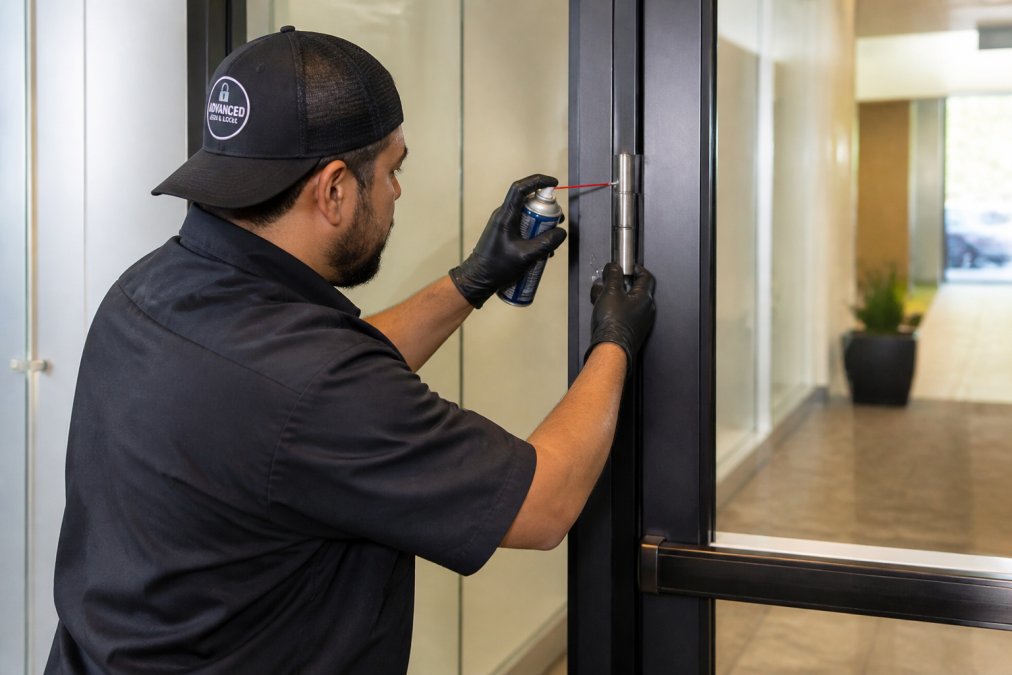
Dirt and dry metal are door hardware's two biggest enemies. Cleaning removes grit that grinds down moving parts; the right lubricant keeps them gliding. But "the right lubricant" isn't one product, it depends on the part, the metal, and how much dust the door sees.
Clean First, Lubricate Second
Lubricant over grit becomes an abrasive paste. Wipe hinges, closers, exit devices, and lock bodies with a soft cloth and mild, non-abrasive detergent, then dry before applying anything. Avoid harsh solvents that strip coatings off plated or powder-coated hardware.
Match the Lubricant to the Part
Most guides say "use a lubricant" and stop there, that's how keyways gum up and closers get ruined. Here's how the common product types behave:
| Lubricant type | Best for | Avoid on | Why |
|---|---|---|---|
| Dry-film (PTFE or molybdenum disulfide) | Hinges, pivots, exit device linkages, strike plates | Nothing critical, it is the safest default | Goes on wet, dries to a thin film that does not attract dust |
| Silicone spray | Weatherstripping, rubber seals, sliding surfaces, threshold sweeps | Lock cylinders | Repels water and keeps rubber pliable, but leaves a film that can trap grit in a keyway |
| Graphite powder | Lock cylinders and keyways | Hinges, pivots, exposed linkages | Dry and dust-friendly inside a closed cylinder, but messy and abrasive on open bearing surfaces |
| Lithium grease | Heavy-duty hinges, overhead track rollers, high-load pivots | Lock cylinders, closers, anything sealed | High load capacity, but it is thick and collects debris in exposed spots |
| Light machine oil (such as a general-purpose penetrating oil) | Temporary freeing of a seized pin or rusted fastener | Long-term use on any door hardware | Creeps into tight spaces, then attracts dust and evaporates over time |
A few rules follow from that table:
- Lock cylinders and keyways: use graphite or a dry-film lubricant. Never a wet oil, it traps dust, and the keyway will jam within weeks.
- Hinges and pivots: a dry-film lubricant is the safest choice for most commercial doors. It will not stain the door or collect lint the way oil does.
- Door closers: most modern closers are sealed hydraulic units and need no added oil. Adding oil to the wrong port can contaminate the hydraulic fluid and void the warranty. Follow the manufacturer's guidance.
- Exit devices and panic bars: a light dry-film lubricant on the moving linkage. Avoid grease, which can stiffen in cold weather and slow the bar's return.
- Stainless steel and aluminum hardware: dry-film or silicone. Avoid graphite on visible stainless, it smears and is hard to remove.
How Often to Lubricate
Lubrication isn't a once-a-year task. A reasonable baseline:
- High-traffic entrances: inspect and re-lubricate hinges, pivots, and exit device linkages monthly.
- Standard office doors: quarterly.
- Low-use storage or back-of-house doors: twice a year.
- Lock cylinders: only when a key starts to feel gritty, over-lubricating a clean cylinder is what causes most keyway problems.
What Not to Do
- Do not use WD-40-style multi-purpose sprays as a long-term hinge lubricant. They are solvents with a light oil, and they evaporate, leaving the hinge drier than before.
- Do not mix lubricant types on the same part. Graphite over oil, or oil over dry-film, creates a gummy layer.
- Do not lubricate a closer that is leaking hydraulic fluid. The leak is the failure, lubrication will not fix it.
- Do not spray lubricant onto a door's finish or glass. Mask or wipe immediately; silicone and oil can stain porous surfaces and etch some coatings.
Tightening Loose Hardware and Fixing Alignment Issues
Loose fasteners and misalignment cause most door problems, and both are fixable in minutes. A door that sags or won't latch is usually just out of line.
Seasonal Maintenance and ADA Compliance Checks
Doors face different stress each season, so a seasonal schedule keeps hardware ahead of the weather. Cold snaps stiffen lubricants and shrink seals; humid summers speed corrosion and swell wood doors. It's also the right time to confirm accessibility compliance, a closer adjustment that fixes a slam can quietly push a door out of compliance.
Seasonal Maintenance Schedule
| Season | Focus | Specific tasks |
|---|---|---|
| Spring | Recover from winter | Deep-clean hardware, inspect for salt and moisture damage, check thresholds and floor sweeps for winter wear, re-lubricate hinges and pivots |
| Summer | Humidity and heat | Watch for corrosion on steel and plated parts, check weatherstripping for swelling or gaps, confirm closers still control the door as hydraulic fluid thins in heat |
| Fall | Prepare for cold | Lubricate all moving parts before temperatures drop, test closers in cool morning air, inspect door sweeps and seals, tighten all fasteners |
| Winter | Cold-weather function | Confirm closers still close the door fully in low temperatures, check that exit devices release cleanly when grease stiffens, clear ice and salt from thresholds |
A common cold-climate pattern: a closer that worked all summer won't latch the door in January. The hydraulic fluid thickens, the spring works harder, and latch speed drops. That's a seasonal adjustment, not a failed closer.
ADA Compliance: What the Standards Actually Require
The ADA Standards for accessible design treat door hardware as an access requirement, not a comfort feature. The thresholds most often cited in facility maintenance are:
- Opening force: interior hinged doors generally must open with no more than 5 pounds of force. Fire doors are exempt from the 5-pound limit but still must meet the closing and latching requirements.
- Closing speed: from an open position of 90 degrees, the door must take at least 5 seconds to move to a point 12 degrees from the latch.
- Hardware operation: operable parts must be usable with one hand and without tight grasping, pinching, or twisting of the wrist.
- Reach range: operable parts generally must sit between 15 and 48 inches above the finished floor.
- Thresholds: vertical changes at a doorway are generally limited to 1/2 inch, with 1/4 inch maximum if the change is vertical and beveled.
Post-Adjustment Compliance Checklist
Run this after any closer adjustment, hinge replacement, or threshold work:
- Door opens with light force (verify with a door pressure gauge if you have one; a fish scale works in a pinch)
- Closer returns the door fully and takes at least 5 seconds from 90 degrees to 12 degrees from latch
- Latch engages fully without needing a push
- Threshold is level and within the height limit
- Hardware is reachable and operable with one hand, no tight grasping or twisting
- Exit device releases the latch with less than the force the manufacturer specifies
Documenting Compliance
Keep a simple record per door: date of last adjustment, opening force reading if measured, closer timing if tested, and who did the work. If an accessibility complaint arises, that log is the difference between a quick resolution and a costly retrofit, and it tells the next technician the baseline the door must meet.
When to Call a Professional Locksmith
Some jobs are simple adjustments. Others need a trained hand. Call a professional locksmith when the problem involves the lock itself, the door frame, or anything tied to security.
Reach out to a pro when:
- A lock cylinder is worn and keys no longer turn smoothly.
- The door frame is damaged or the strike plate won't hold.
- An electronic access control system needs repair or reprogramming.
- A closer or exit device needs full replacement.
- You manage multiple doors and need a master key system.
Frequently Asked Questions
How often should commercial door hardware be inspected?
High-traffic doors in retail or office settings need weekly visual checks and monthly hands-on inspections. Lower-traffic doors can be inspected quarterly. At minimum, run through a full commercial door hardware inspection checklist twice a year. Look for loose screws, worn weatherstripping, slow closers, and latch bolts that don't fully extend. Catching small issues early prevents emergency service calls and extends hardware lifespan.
What are the most common signs of commercial door hardware failure?
Watch for doors that stick or drag on the threshold, closers that slam or fail to latch, hinges that squeak or show rust, and keyways that feel gritty when you turn the key. A latch bolt that doesn't fully engage the strike plate is a security risk. Misalignment between the door and frame often signals hinge wear. Any of these signs of failing commercial door hardware should be addressed before the door stops working entirely.
Is it necessary to hire a professional for commercial door maintenance?
Routine tasks like cleaning, tightening screws, and applying dry lubricant are safe for facility staff. But door closer adjustment, hinge realignment, and electronic access control repairs require a certified locksmith. Improper adjustments can damage the closer or create ADA compliance issues. If you're unsure whether a fix is within your scope, a professional inspection is worth the cost compared to replacing hardware prematurely.
What cleaning agents are safe for commercial door hardware finishes?
Use a non-abrasive detergent mixed with warm water and a soft cloth. Avoid ammonia-based cleaners, bleach, and abrasive pads, which strip protective coatings from brass, stainless steel, and anodized aluminum. For electronic locks and keypads, use manufacturer-approved wipes. Dry the surface immediately after cleaning to prevent water spots and corrosion. Never spray cleaner directly into a keyway or electronic component.
Doors fail at the worst possible times, usually after hours when a jammed lock locks out your team. Advanced Keys & Locks LLC keeps commercial doors secure with 24/7 emergency service, upfront pricing, and certified, insured locksmiths. We repair closers, hinges, exit devices, and access control systems, and we install master key systems for multi-door buildings. Get a quote from Advanced Keys & Locks LLC and keep every door closing, latching, and locking the way it should.