 ultimate-guide
Residential Lock Upgrade Cost Guide 2026: What to Expect
Table of Contents
- What Drives Residential Lock Upgrade Costs in 2026
- Average Cost to Rekey Locks vs. Full Replacement
- Smart Lock Installation Cost and Integration Factors
- Locksmith Labor Rates 2026: What You're Paying For
- Lock Types and Security Levels: A Visual Identification Guide
- Insurance, Warranty, and Maintenance Implications
- Frequently Asked Questions
Last Updated: September 14, 2026
What Drives Residential Lock Upgrade Costs in 2026
A residential lock upgrade cost guide for 2026 starts with one honest answer: there is no single price. What you pay depends on the hardware grade, the door, and whether existing boreholes and backset measurements match the new hardware. At Advanced Keys & Locks LLC, two homes with identical door counts can land hundreds apart.
Lock upgrade cost is the total of hardware, labor, and any door modification required to fit new hardware. Hardware sets the floor. Labor and door prep set the ceiling.
Hardware Grade and Security Level
The biggest single variable is the grade of the lockset you buy. Residential hardware is rated under ANSI/BHMA A156.36 standards for auxiliary locks, which classify deadbolts and knobs into Grade 1, Grade 2, and Grade 3 based on cycle testing and strike strength. Grade 3 is builder-grade, entry-level hardware common on new construction. Grade 2 is the mid-range sweet spot for most homes. Grade 1 is commercial-grade and rarely necessary on a single-family front door.
Upgrading from a Grade 3 knob lock to a Grade 2 deadbolt changes both the hardware line and the labor line, because a deadbolt requires a second bore and a reinforced strike plate. That's a different job than swapping a like-for-like knob.
Door Type and Existing Hardware
Door material matters more than most homeowners expect. A hollow-core interior door takes a cylindrical lock or knob set with minimal prep. A solid wood or fiberglass exterior door can accept a mortise lock, which requires a larger routed pocket and costs more in labor. Steel doors need specific hardware and often a reinforcement plate.
Existing boreholes are the quiet cost driver. If your door already has a 2-1/8 inch cross bore and a 1 inch edge bore, most standard deadbolts drop in with minimal work. Moving from a knob-only setup to a deadbolt-and-handle set means additional drilling and chiseling, that's where a phone quote and an on-site quote diverge.
Average Cost to Rekey Locks vs. Full Replacement
Rekeying is almost always cheaper than replacement, and it's the right call more often than homeowners realize. Rekeying means changing the internal pins of an existing lock cylinder so old keys no longer work, while keeping the same hardware. Replacement means removing the old lock and installing new hardware entirely.
The gap comes down to parts and time. A rekey uses a pin kit and new keys; a replacement uses a new lockset, a new deadbolt, or both. For a single door, rekeying is the entry-level option. For a whole house where the hardware is worn, mismatched, or Grade 3, replacement usually makes more sense.
The Cost Math, Side by Side
Rekeying and replacement aren't just different prices; they're different scopes of work. A rekey is a pin change; a replacement is a removal, a fit, and often a door-prep step, which is why the labor line moves more than the hardware line.
| Job | What's included | Cost driver |
|---|---|---|
| Rekey, single cylinder | New pins, new keys, old hardware stays | Labor time, key count |
| Rekey, whole house | Multiple cylinders pinned to one key | Per-cylinder labor, key count |
| Replace, like-for-like | New lockset or deadbolt, same bore | Hardware grade |
| Replace, added deadbolt | New deadbolt plus a second bore and strike | Hardware plus door prep |
| Replace, mortise conversion | New cylindrical hardware, pocket filled | Hardware plus finish work |
The pattern most homeowners see: rekeying is the cheapest way to invalidate old keys, and replacement is the only way to change the grade or add smart functionality. If your goal is "old keys shouldn't work," rekey. If your goal is "this door should be more secure," replace.
When Rekeying Makes Sense
Rekeying makes sense when the hardware is in good condition, the grade is acceptable, and you simply need old keys to stop working: a new home purchase, a tenant turnover, a lost key, or a roommate move-out.
Rekeying also makes sense when you want a master key system across multiple doors without replacing every lock. A locksmith can pin existing cylinders to a master key hierarchy, so one key opens common areas while individual keys stay restricted to specific doors. That's a practical upgrade path for property managers and small business owners.
Replacement becomes the better call when the hardware is failing, when you want to move up a security grade, or when you're adding smart lock functionality the existing hardware can't support.
A Decision Framework You Can Apply Door by Door
Run each exterior door through these four questions before you call anyone:
- Is the hardware in good condition? If the cylinder turns smoothly and the bolt seats fully, rekey. If it sticks, wobbles, or the bolt doesn't extend, replace.
- What grade is it? Grade 3 hardware is builder-grade. Rekeying a Grade 3 lock keeps a Grade 3 lock. If security is the goal, replace.
- Do you want smart functionality? Most smart locks replace a deadbolt rather than a knob. If there's no deadbolt, you're replacing, not rekeying.
- How many doors share a key? One key for the whole house is a rekey job. One key for the house plus a separate key for a rental unit is a master key job, which is also a rekey.
If you answer "replace" on two or more questions for the same door, replacement is the better spend. If you answer "rekey" on three or more, rekeying is the efficient choice.
The Hidden Cost of Rekeying Worn Hardware
Rekeying a worn cylinder doesn't restore security. The pins are new, but the cylinder body, the bolt, and the strike plate are as old as the door. A worn bolt that doesn't fully seat is a lockout waiting to happen, and no pin change fixes that. If the hardware is near end of life, you'll pay for the rekey and then pay again for the replacement.
| Situation | Better Option | Why |
|---|---|---|
| New home, keys unaccounted for | Rekey | Cheapest way to invalidate old keys |
| Worn or mismatched hardware | Replace | Rekeying worn cylinders doesn't restore security |
| Tenant turnover | Rekey | Fast, low-cost, no hardware waste |
| Adding smart lock | Replace | Most smart locks require new hardware |
| Upgrading to Grade 1 | Replace | Grade is a hardware property, not a pin property |
| Building a master key system | Rekey | Existing cylinders can be pinned to a hierarchy |
Smart Lock Installation Cost and Integration Factors
Smart lock installation cost is where most guides get vague. The honest answer: a smart lock is a hardware purchase plus an installation plus, sometimes, a hub and wiring.
Three factors drive the number: the lock itself, which ranges from entry-level keyless entry to premium models with built-in Wi-Fi, fingerprint readers, and Z-Wave or Zigbee radios; whether your door is already prepped for a deadbolt, since most smart locks replace a deadbolt rather than a knob; and whether you need a hub or bridge for the lock's protocol.
A common mistake is buying a smart lock before checking the door's existing bore. A smart deadbolt needs a standard 2-1/8 inch cross bore and 1 inch edge bore. Older doors with non-standard prep require additional drilling, which changes the labor line.
Integration adds a second layer. If you want the lock to talk to a broader system (access control for a small office, or a home automation platform), you may need a compatible hub and a configuration step, a setup cost, not a hardware cost, and where a certified installer saves you time.
Locksmith Labor Rates 2026: What You're Paying For
Locksmith labor rates in 2026 reflect three components: the service call fee, the per-lock labor rate, and any emergency premium. A scheduled job during business hours is the cheapest configuration. An emergency service call at 2 AM on a Sunday is the most expensive.
The service fee covers the trip and the first block of time. The per-lock labor rate covers the work on each cylinder or lockset. Emergency premiums apply outside standard hours, on holidays, and for lockouts where the technician is dispatched immediately.
Residential locksmiths typically quote the service fee upfront and the per-lock rate once they see the job. That's why a phone quote and a final invoice can differ. Reputable shops give a firm range on the phone and confirm it on arrival before starting work.
Emergency Service Calls vs. Scheduled Work
Emergency lockouts are priced differently from scheduled upgrades. A lockout is a single-event job with a dispatch premium; a lock upgrade is planned work with a predictable scope. If you're locked out right now, you're paying for speed. If you're planning an upgrade, you can schedule it at a lower rate.
If you're a renter, check with your landlord before authorizing any work. Many leases require landlord approval for lock changes, and some landlords cover the cost. Rekeying is usually permitted without approval because it doesn't alter the hardware; replacement may need sign-off.
Lock Types and Security Levels: A Visual Identification Guide
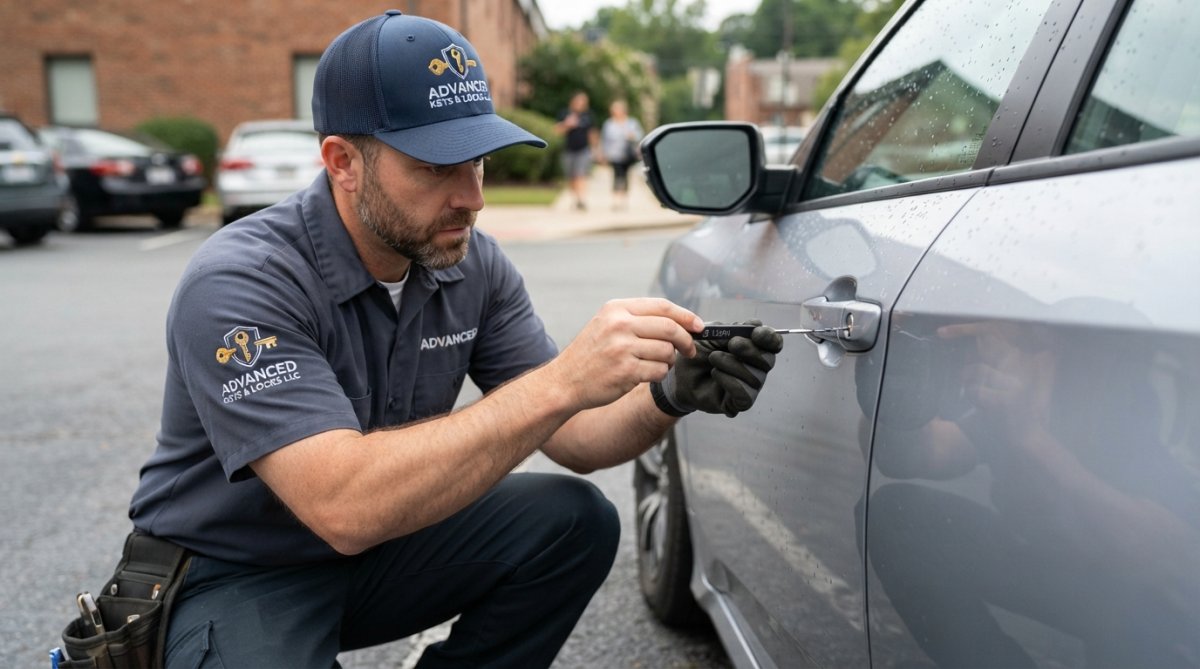
Knowing what you're looking at is the first step to pricing an upgrade. Most residential doors use one of four lock types, each with a different cost profile. Match your door to a type, then read the cost and labor implications.
How to Identify Your Current Lock in Under a Minute
Stand on the inside of the door and look at the edge. The shape of the faceplate and the position of the cylinder tell you almost everything.
- Knob lock: The cylinder is built into the knob itself. The faceplate on the door edge is small and rounded. Common on interior doors and older exteriors. Entry-level security, cheapest to replace.
- Cylindrical lock: The cylinder sits in the body of the lockset, not the knob. The faceplate is a rounded rectangle, and you'll see a separate deadbolt above it on most exterior doors. Standard on most residential exteriors. Mid-range cost.
- Mortise lock: A rectangular lock body set into a routed pocket in the door edge. The faceplate is long and rectangular, often 6 to 8 inches tall, with the knob and deadbolt sharing one body. Found on older homes and higher-end doors. Highest labor cost because of the door prep.
- Deadbolt: A separate bolt that extends into the door frame. The primary security layer on an exterior door. Can be single-cylinder (key outside, thumb turn inside) or double-cylinder (key both sides). Double-cylinder deadbolts are a code concern in some jurisdictions because they can trap occupants during a fire; check local rules before installing one on an egress door (codes.iccsafe.org).
A quick measurement confirms the type. Measure the backset, the distance from the door edge to the center of the borehole. Standard is 2-3/8 inches or 2-3/4 inches. If your backset matches, most replacement hardware drops in. If it doesn't, you're looking at a re-bore, a labor line, not a hardware line.
What Each Type Costs to Upgrade
Hardware and labor move together by lock type. These are the patterns most practitioners see, not fixed quotes:
| Lock type | Typical hardware tier | Labor profile | Upgrade path |
|---|---|---|---|
| Knob lock | Entry-level | Lowest, like-for-like swap | Replace with a cylindrical lockset or add a deadbolt |
| Cylindrical lock | Mid-range | Low to moderate | Swap the lockset, or add a separate deadbolt |
| Mortise lock | Mid to high | Highest, requires routing | Replace the mortise body, or convert to cylindrical with door prep |
| Deadbolt | Mid to high | Low if the bore already exists | Swap the deadbolt, or upgrade the grade |
The costliest mistake is buying hardware before identifying the type. A mortise-to-cylindrical conversion leaves an oversized pocket in the door edge that has to be filled or covered, finish work on top of the lock work.
Security Level Tracks the ANSI Grade
Security level tracks the ANSI grade, which is a hardware property, not a pin property. Grade 3 is entry-level, Grade 2 is mid-range, and Grade 1 is high-security. Bump-proof and pick-resistant cylinders add to the hardware line without changing the labor.
Matching the Lock to the Door
Door material constrains the choice. A hollow-core interior door takes a cylindrical lock or knob set with minimal prep and shouldn't carry a heavy mortise body. A solid wood or fiberglass exterior door can accept a mortise lock. Steel doors need specific hardware and often a reinforcement plate. Identify the door material and the lock type together before you price anything.
Insurance, Warranty, and Maintenance Implications
An upgraded lock can affect more than your security. Homeowners insurance policies sometimes offer premium discounts for verified security upgrades, particularly with a monitored alarm or a Grade 1 deadbolt. Check with your insurer before assuming a discount applies; terms vary by carrier and policy.
Warranty is the second consideration. Most manufacturers warrant their locks against mechanical failure for a set period, but that warranty is void if the lock is installed incorrectly or modified. Professional installation protects the warranty; a bad DIY job can void it.
Maintenance is the third. Locks need occasional lubrication with a graphite or PTFE-based product, not oil, which attracts dirt. Annual inspection of strike plates and mounting screws catches small failures before they become lockouts. A smart lock adds a battery replacement cycle and, occasionally, a firmware update.
Lock upgrades aren't a single purchase; they're a decision about how much security you actually need and how long you want it to last. The wrong choice costs you twice, once in hardware and once in a re-do. Advanced Keys & Locks LLC handles residential lock upgrades, rekeys, smart lock installations, and master key systems with upfront pricing and no hidden fees, backed by certified and insured locksmiths available 24/7. If you want a firm number instead of a guess, get a quote and we'll walk your doors with you.
Frequently Asked Questions
Is it cheaper to rekey locks or replace them entirely?
Rekeying is almost always cheaper because you keep the existing hardware and only change the internal pins. The average cost to rekey locks is lower than full replacement, especially if your current locks are in good condition and meet modern security standards. However, if your locks are old, damaged, or low-grade, replacing them with ANSI Grade 1 or Grade 2 deadbolts makes more sense for long-term security and may save money on future maintenance.
How much does a professional locksmith charge to replace a door lock in 2026?
Locksmith labor rates 2026 vary based on your location, the time of service, and the complexity of the job. Standard business-hours installation typically costs less than emergency or after-hours calls. The total also depends on whether you supply the hardware or the locksmith provides it. For an accurate quote, contact a licensed locksmith directly and ask for a breakdown of labor and materials before work begins.
What factors influence the total cost of a residential lock upgrade?
Key factors include the type of lock (knob, deadbolt, mortise, or smart lock), the security grade of the hardware, the number of doors involved, and whether you need structural modifications. Labor rates, emergency service fees, and whether you choose rekeying versus full replacement also affect the final price. Upgrading to high-security or smart locks adds cost but can improve insurance eligibility and long-term convenience.
How much do smart lock installations cost compared to traditional deadbolts?
Smart lock installation cost is generally higher than installing a standard deadbolt because it involves additional steps like connecting to Wi-Fi, pairing with an app, and sometimes adjusting the door for compatibility. The hardware itself also costs more. However, many homeowners find the added convenience, remote access, and keyless entry features worth the investment, especially for rental properties or homes with frequent guests.
Are there hidden fees when hiring a locksmith for a home security upgrade?
Reputable locksmiths provide upfront pricing with no hidden fees. Ask for a written estimate that includes the service call fee, labor rate, and hardware costs before work starts. Be wary of quotes that seem unusually low, as they may lead to surprise charges after the job. A certified, insured locksmith will be transparent about all costs and will not pressure you into unnecessary upgrades.
How long does a professional lock upgrade typically take?
A standard deadbolt replacement or rekey usually takes 30 to 60 minutes per door. Smart lock installation may take slightly longer due to app setup and testing. If you are upgrading multiple doors or installing a master key system, plan for a half-day or full-day appointment. Emergency lockout service is faster, often resolving in under an hour once the technician arrives.