 listicle
Bulk Pricing for Rental Lock Replacement: 2026 Cost Guide
Table of Contents
- Why Bulk Pricing for Rental Lock Replacement Changes the Math
- Rental Property Lock Replacement Cost: What You Pay Per Lock
- Bulk Lock Rekeying vs. Replacing Locks at Scale
- Commercial Lock Installation Cost for Multi-Door Properties
- How Property Management Locksmith Services Handle Volume Work
- Turnover Planning: Scheduling Bulk Lock Work Around Move-Outs
- Master Key Systems, Key Control, and Access Implications
- Building a Portfolio Budget and Getting a Sample Quote
- Frequently Asked Questions
Last Updated: October 17, 2026
Why Bulk Pricing for Rental Lock Replacement Changes the Math
Bulk pricing for rental lock replacement is a volume-based rate a locksmith charges when one owner needs many locks rekeyed or replaced in one coordinated job.
A single lockout or one-lock swap carries a service call, minimum charge, and travel time unrelated to the lock itself.
Below: what drives per-lock costs, when rekeying beats replacing at scale, and how to budget a full portfolio.
Rental Property Lock Replacement Cost: What You Pay Per Lock
Rental property lock replacement cost breaks into four parts: hardware, labor, the service call, and any minimum charge the shop applies. Published guides put basic professional lock replacement somewhere in a broad per-lock range, with Angi's door lock replacement cost guide noting that lock type and security features are the main cost drivers. High-security hardware sits at the top of that range.
Published Per-Lock Ranges and What Drives Them
What moves the number:
- Lock grade. Builder-grade knobs cost far less than ANSI Grade 1 deadbolts.
- Cylinder type. Standard pin cylinders are cheapest; high-security restricted keyways cost more.
- Door prep. A retrofit into an existing bore is faster than cutting new hardware in.
Service Call, Minimum Charge, and Labor
The service call is a flat trip fee. The minimum charge is the floor a shop bills for showing up, even for a fifteen-minute job. Labor is billed per lock or per hour. On a single unit, these three can rival hardware cost; on a twenty-door batch, they spread thin. That spread is where bulk pricing for rental lock replacement does its work.
Bulk Lock Rekeying vs. Replacing Locks at Scale
Bulk lock rekeying is almost always cheaper per door than replacement, because you keep the existing hardware and pay only for new pins and labor. Rekey when hardware is sound and old tenant keys just need to stop working; replace when locks are worn, mismatched, or below the grade you want.
The decision comes down to condition:
| Situation | Better Choice | Why |
|---|---|---|
| Hardware in good shape, tenant moved out | Rekey | Lower per-cylinder cost, same security result |
| Locks mismatched or builder-grade | Replace | Standardizes the property and upgrades grade |
| Keys unaccounted for across many units | Replace or master-key | Restores full key control |
| Mixed-age portfolio | Rekey the good doors, replace the rest | Balances budget against risk |
Commercial Lock Installation Cost for Multi-Door Properties
Commercial lock installation cost runs higher than residential work for a simple reason: commercial doors carry heavier hardware, closer requirements, and often panic hardware or electrified strikes. Doors for Pros' lock change cost breakdown frames its estimates for contractors and facility managers and notes that commercial-grade setups can exceed the residential band per door.
On a multi-door property, the per-door headline number is the wrong number to negotiate against. What moves the invoice is how the shop structures volume: most locksmiths serving rental portfolios use a tiered schedule keyed to door count per visit, not total spend across the year.
How Volume Tiers Typically Work
A common pattern in the trade is a three- or four-step schedule:
- Single door / service call: full service call, minimum charge, and full labor rate. This is the rate published on most cost guides.
- Small batch (roughly 5-10 doors at one address): service call waived or reduced, per-lock labor trimmed, hardware at list or near list.
- Mid batch (roughly 11-25 doors): one mobilization fee for the property, per-lock labor at a discounted rate, and hardware at a modest trade discount.
Exact breakpoints vary by shop and market, so treat those ranges as a negotiation frame, not a price list. The mechanism matters: fixed costs divide across more doors, and labor steps down as repetition makes each door faster.
Minimum Quantities and What Counts Toward Them
Ask any volume locksmith two questions before comparing bids: what is the minimum door count for the batch rate, and does the count include shared entrances, mailbox locks, and outbuildings?
Also confirm whether the tier is measured per visit or per contract. Per-visit rewards batching everything into one mobilization; per-contract may let you spread the same door count across several trips at the same rate.
Splitting the Scope: Unit Doors vs. Shared and Perimeter Doors
A property with a shared entrance, a rear service door, and a dozen unit doors is three different hardware conversations. We quote those separately, then apply volume pricing across the unit doors where the work repeats. One blended per-door rate hides the fact that unit-door work is the repeatable, discountable portion.
What Commercial Volume Pricing Does Not Cover
Volume rates apply to scheduled, batched work, not emergency lockouts, after-hours calls, or one-off service between visits. If a tenant locks out at 11 p.m., expect the standard emergency rate regardless of door count.
For a multi-door building, the per-door figure matters less than total scope and the tier it lands in. Get the tier structure in writing, confirm what counts toward the minimum, and separate repeatable unit-door work from one-off commercial hardware before you sign.
How Property Management Locksmith Services Handle Volume Work
Property management locksmith services handle volume work by batching it: one scheduled visit, one crew, one invoice, and a documented key log for every door touched. That structure makes a volume rate possible and gives you a paper trail when a tenant disputes a deposit or a key goes missing.
The workflow on multi-unit jobs often looks like this:
- Scope the property. Count doors and note hardware condition per unit.
- Split rekey from replace. Tag each door before pricing.
- Batch the visit. Group units by building and floor to cut travel.
- Document key control. Record every key issued and returned.
- Invoice once. One quote, one bill, no per-trip surprises.
Turnover Planning: Scheduling Bulk Lock Work Around Move-Outs
Turnover planning is where bulk pricing for rental lock replacement actually gets earned.
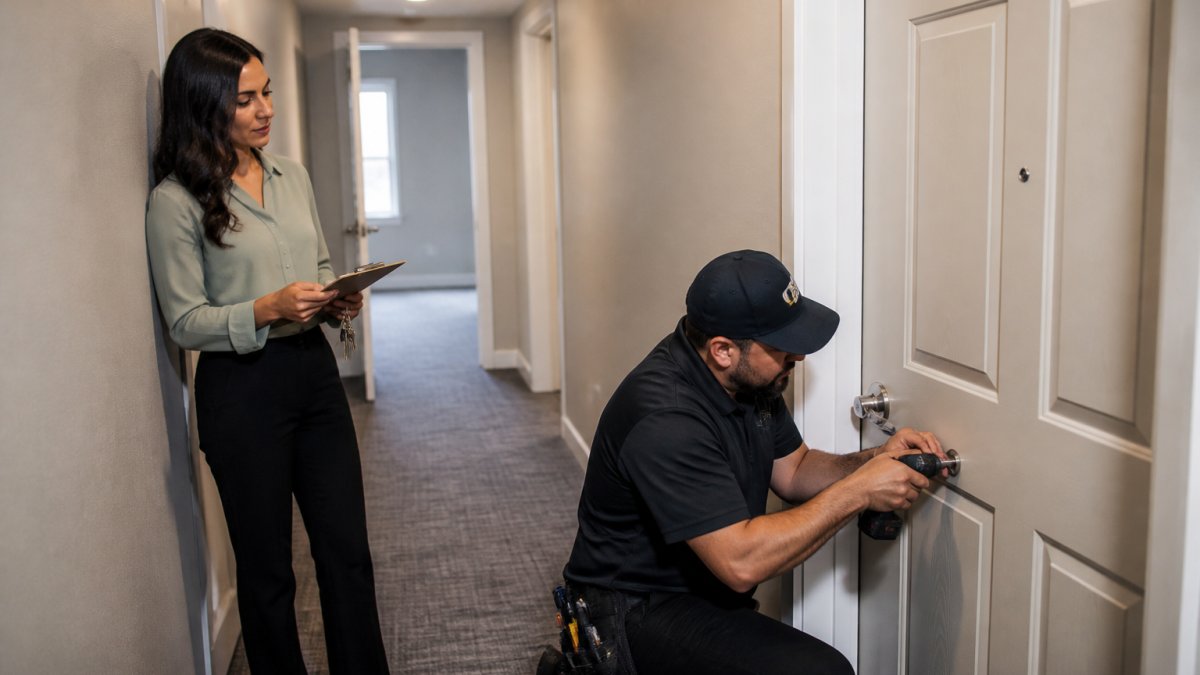
The practical sequence: confirm move-out dates, schedule lock work for the gap between tenants, and give the locksmith the full unit list at booking.
Master Key Systems, Key Control, and Access Implications
A master key system lets one key open every unit while each tenant key opens only its own door.
Key control is the other half: restricted keyways stop tenants from copying keys at a hardware store, keeping the master key genuinely master. Decide on the access structure before the batch is quoted, retrofitting master keying onto installed locks means paying twice.
Building a Portfolio Budget and Getting a Sample Quote
Portfolio budgeting starts with a door count, not a guess. List every unit door, shared entrance, mailbox lock, and outbuilding, tag each rekey or replace, then request a batch quote against that list. A sample quote should show the per-lock rate, door count, service call, and total so you can compare vendors on the same scope.
Here is a budgeting checklist for property managers:
- Count every door, including shared and mailbox locks
- Tag each door rekey or replace
- Note hardware grade and any high-security needs
Sample Budgets by Property Size
The numbers below are illustrative assumptions, not published rates, plug in your own local quotes. The point is the structure: fixed costs spread across doors, labor steps down with volume, and hardware is quoted separately so you can see what the discount applies to.
Small property, 6 unit doors, rekey only, hardware sound.
| Line item | Assumption | Amount |
|---|---|---|
| Service call / mobilization | one trip | $75 |
| Per-cylinder rekey labor | 6 × $25 | $150 |
| New keys | 2 per unit × 6 | $30 |
| Hardware | none | $0 |
| Total | $255 | |
| Per door | ~$42.50 |
Mid property, 18 unit doors, mixed rekey and replace.
| Line item | Assumption | Amount |
|---|---|---|
| Mobilization | one trip, waived at tier | $0 |
| Rekey labor | 12 × $22 | $264 |
| Replacement labor | 6 × $35 | $210 |
| Standard deadbolt hardware | 6 × $30 | $180 |
| New keys | 2 per unit × 18 | $90 |
| Total | $744 | |
| Per door | ~$41.30 |
Portfolio, 40 unit doors across two buildings, replace all with standard grade.
| Line item | Assumption | Amount |
|---|---|---|
| Mobilization | one per building | $100 |
| Replacement labor | 40 × $28 | $1,120 |
| Standard deadbolt hardware | 40 × $28 | $1,120 |
| New keys | 2 per unit × 40 | $200 |
| Total | $2,540 | |
| Per door | ~$63.50 |
Notice what happens to the per-door number as scope grows: fixed mobilization nearly disappears and labor steps down.
What an Itemized Quote Should Show
A quote you can actually compare against another vendor should itemize, at minimum:
- Door count by type, unit doors, shared entrances, perimeter and service doors, mailbox locks.
- Action per door, rekey, replace, or master-key.
- Hardware line, brand, grade, and per-unit price, or "landlord-supplied" if you are providing your own.
- Labor rate, per lock or per hour, and which.
- Mobilization / service call, flat fee, and whether it is waived at the tier.
- Key charge, how many keys per door and the per-key price.
- Volume tier applied, the door count that triggered it and the rate before and after.
- Exclusions, emergency calls, after-hours, door prep, and any hardware the shop will not warranty.
If a vendor will not break the quote out this way, you cannot tell whether the "volume discount" is real or just a blended rate that hides a marked-up hardware line.
Comparing Bids on the Same Scope
Send every vendor the same door list and rekey-or-replace tags, then compare four numbers: total, per-door effective rate, mobilization fee, and hardware unit price. A bid that looks cheaper on total but carries a higher hardware unit price may cost more the moment you add doors. A bid higher on per-door labor but waiving mobilization and including a hardware warranty may be the better portfolio deal.
On pricing, we quote each property against its actual door list rather than publishing a flat rate, because hardware and scope vary too much for one number to be honest. You can request a quote from Advanced Keys & Locks LLC against your own unit list and see the per-door math before you commit.
Frequently Asked Questions
Do locksmiths offer bulk pricing for rental property lock replacement?
Many do, but the discount usually depends on the number of doors, whether hardware is supplied in one order, and how much of the work can be scheduled in a single visit. Bulk pricing is typically quoted per project rather than published as a flat rate. Ask for a written quote that breaks out per-lock pricing, labor charge, and any travel fee so you can compare vendors on the same scope. Vendors that serve property portfolios often build volume tiers into their quotes.
Is it cheaper to rekey rental locks or replace them at scale?
Rekeying is usually the lower-cost option per cylinder because you keep the existing hardware and only change the pins. Replacing makes more sense when the hardware is worn, mismatched, or you want key control across a portfolio. For a large turnover, a mix of both is common.
What affects the cost of replacing locks across multiple rental units?
The main drivers are the number of doors and cylinders, lock type and grade, whether new hardware is needed, and how accessible the units are on the scheduled day. Labor charge and any minimum charge or service call fee also apply, and after-hours or emergency service costs more. Location and service area create price variation too. Get a cost estimate that lists each unit so the quoted price matches the total cost at invoicing.
What should a property manager include in a bulk lock replacement quote?
Ask for a line-item quote covering per-lock or per-cylinder pricing, labor charge, hardware and replacement hardware costs, service call or minimum charge, and any travel fee. Include the number of doors and units, the lock type for each, whether rekeying or replacement is planned, and the target turnaround time. Confirm whether volume discounts apply at your unit count and whether the price is fixed before work starts. This protects your budget and avoids surprise charges.
How long does it take to replace locks in multiple rental units?
A single lock swap typically takes 15 to 30 minutes, so a 20-unit turnover can often be completed in one to two working days if access is arranged in advance. Rekeying is usually faster per cylinder than full replacement. Scheduling matters more than the work itself: group units by building, confirm tenant move-out dates, and give the locksmith a key or access plan. Ask for a turnaround time in writing so the schedule matches your lease start dates.
The challenge with rental lock work is that single-job pricing quietly punishes landlords who own more than one door. Advanced Keys & Locks LLC quotes multi-unit work as a batch, with upfront pricing and no hidden fees, certified and insured locksmiths, and 24/7 availability when a turnover or lockout will not wait. Get a quote from Advanced Keys & Locks LLC and price your whole portfolio on one visit instead of twelve.