 how-to
Find a Certified Locksmith Without Hidden Fees
Table of Contents
- How to Verify a Locksmith Is Certified and Licensed
- Understanding Locksmith Upfront Pricing and Fee Breakdowns
- The Locksmith Service Call Fee and What It Covers
- Use a Locksmith Quote Checklist Before Dispatch
- What to Do When the On-Site Quote Changes
- How to Compare Locksmith Quotes Fairly
- Frequently Asked Questions
Last Updated: October 7, 2026
How to Verify a Locksmith Is Certified and Licensed
Finding a certified locksmith hidden fees starts with confirming credentials and understanding what to look for. Understand what certifications mean and how to verify them in your jurisdiction.
Check Professional Certifications and Credentials
A certified locksmith has completed training and passed profession-specific exams, proving they know industry standards, security principles, and safe practices (ALOA CERTIFICATION).
Look for these credentials:
- Certified Locksmith (CL): Issued by the Associated Locksmiths of America (ALOA) after passing a comprehensive exam
- Certified Professional Locksmith (CPL): Higher-level ALOA credential requiring additional experience and testing
- Certified Master Locksmith (CML): Advanced certification demonstrating expertise in complex systems
Ask directly: "What certifications do you hold?" A legitimate professional answers immediately, naming the issuing organization and the year earned.
Verify ALOA certifications on their official website by searching the member directory by name or business. Two minutes confirms the credential is real.
Confirm Insurance and Bonding Status
Insurance and bonding protect you if something goes wrong. A bonded locksmith has posted a financial guarantee that covers your loss if they damage your property or steal from you.
Insurance covers liability. If a locksmith injures themselves or damages your home, their insurance pays for repairs.
Ask these questions:
- "Are you insured?" (They should say yes without hesitation.)
- "What's your insurance company and policy number?" (Write it down.)
- "Are you bonded?" (Again, they should confirm immediately.)
- "Can you email me proof of both before you arrive?" (Professional locksmiths do this routinely.)
Never let anyone work on your locks without proof of insurance and bonding. A one-page document takes 30 seconds to email.
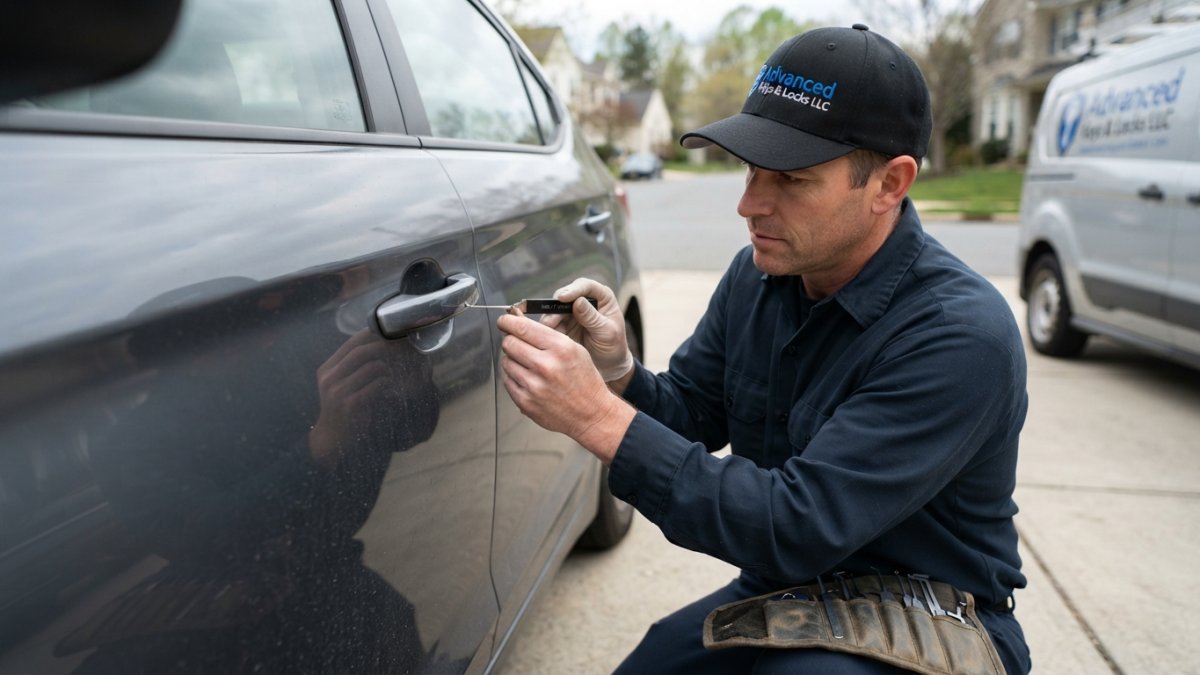
At Advanced Keys & Locks LLC, we provide proof of insurance and bonding upfront.
Verify Local Licensing Requirements by Jurisdiction
Licensing rules differ across the DMV area. Washington, DC, Maryland, and Virginia each have their own requirements.
Washington, DC: Locksmiths must be licensed through the DC Department of Licensing and Regulation (DLLR), which requires a general contractor's or specialized locksmith license.
Maryland: No state locksmith license is required, but many counties and cities do. Baltimore City, for example, requires a locksmiths' license from the Department of Licensing.
Virginia: No state locksmith license is mandated, but some municipalities do. Arlington and Alexandria, for instance, require business licenses. Call your city or county clerk's office to confirm.
To verify licensing:
- Identify your jurisdiction (DC, Maryland city/county, or Virginia city/county)
- Visit that jurisdiction's licensing board website
- Search the locksmith's business name
- Confirm the license is current (not expired)
If a locksmith claims to be licensed but you can't find them online, ask for their license number and call the licensing board directly.
Understanding Locksmith Upfront Pricing and Fee Breakdowns
Transparent pricing means the locksmith explains exactly what you'll pay before work begins. This is how you avoid hidden fees.
What Components Make Up a Locksmith Quote
A complete locksmith quote includes these parts:
Service call fee: The charge to arrive and assess your situation, covering travel time and the initial visit. It varies by location and time of day.
Labor charge: The hourly rate for the technician's work, separate from the service call fee. It's charged hourly or as a flat rate for simple jobs like key duplication.
Parts cost: The actual cost of any locks, keys, hardware, or materials used. The quote should list each part and its price.
After-hours fee: An additional charge for calls outside business hours. Midnight lockouts cost more than noon calls, and this fee should be disclosed upfront.
Minimum charge: Some locksmiths set a minimum total bill. For example, "minimum $85" means you pay at least that amount even if the job takes 10 minutes.
A written estimate lists all these components separately. You see exactly where your money goes.
Why Transparent Pricing Protects You
When a locksmith gives a price range instead of a specific quote, you're vulnerable. "Usually costs between $75 and $200" means the final bill could double your expectation.
Transparent pricing means:
- No surprises when the bill arrives
- You can compare quotes fairly from different locksmiths
- You know what you're paying for (labor vs. parts vs. fees)
- You can make an informed decision about whether to proceed
A locksmith who refuses an estimate before arriving is hiding something. Legitimate professionals quote upfront because they know what the job entails.
The Locksmith Service Call Fee and What It Covers
The service call fee is the charge for the locksmith to come to your location and assess the problem, separate from labor and parts.
This fee covers:
- Travel time and mileage
- The technician's time to evaluate your lock or lockout
- Initial consultation and recommendations
- Dispatch coordination
However, the service call fee should be credited toward the final bill if you hire that locksmith to do the work.
Always ask: "If I hire you, does the service call fee apply toward my final bill?" Get this in writing.
Emergency calls outside business hours carry a higher service call fee, a 2 AM lockout costs more than a 2 PM appointment. This should be disclosed when you call.
Use a Locksmith Quote Checklist Before Dispatch
Before a locksmith arrives, prepare a checklist to confirm pricing details. This prevents surprises and gives you a record.
Questions to Ask Before the Technician Arrives
Call the locksmith and ask these questions before they dispatch a technician. Write down the answers.
Pricing questions:
- What is your service call fee?
- Does the service call fee apply toward my final bill?
- What is your labor rate (hourly or flat rate)?
- Do you have a minimum charge?
- Is there an after-hours or emergency fee? (If so, how much?)
- What time window can you arrive?
Scope questions:
- Can you tell me over the phone what the job will likely cost?
- What parts might you need, and what do they cost?
- Will you provide a written estimate when you arrive?
- What's your cancellation policy if I decide not to proceed?
Credential questions:
- What certifications do you hold?
- Are you licensed in my jurisdiction?
- Are you insured and bonded?
- Can you email me proof before you arrive?
If they won't answer these questions, call someone else.
Red Flags and Scam Warning Signs
Stop and call another locksmith if you see these warning signs:
Over the phone:
- They won't give you any price estimate ("We don't know until we see it")
- They quote an unusually low price to get you to hire them
- They pressure you to hire them immediately
- They refuse to answer questions about licensing or insurance
- They claim they're the "only locksmith available" (not true)
When they arrive:
- They're driving an unmarked van with no business name
- They don't have a uniform or identification badge
- They refuse to show you their license or insurance
- They immediately quote a price much higher than the phone estimate
- They suggest expensive repairs you didn't ask for (like replacing your entire lock when rekeying would work)
- They demand cash only
- They won't provide a written receipt
A scam locksmith's goal is to charge as much as possible before leaving, creating urgency ("I need payment now"), pressure ("This is my only appointment today"), and inflated prices ("That lock is too old, you need a new one").
Legitimate locksmiths like Advanced Keys & Locks LLC provide upfront pricing, show credentials, and explain what they're doing.
What to Do When the On-Site Quote Changes
Sometimes the locksmith arrives and discovers the problem is more complex than the phone assessment suggested. The quote changes.
But the locksmith must explain the change before proceeding. Here's what to do:
Step 1: Ask for a written revised estimate. Don't let them start work without it. The new quote should list what changed and why.
Step 3: Decide whether to proceed. You're not obligated to hire them if the new price is too high.
Step 4: If you disagree, get a second opinion. Call another locksmith. Describe what the first locksmith found. Get a competing quote.
Step 5: Document everything. Keep the written estimates, the revised quote, and any photos of the lock.
Red flag: A locksmith who refuses to give you a revised written estimate or who gets angry when you question the price increase.
How to Compare Locksmith Quotes Fairly
You've called three locksmiths and have three different quotes. How do you know which one is the best deal?
Apples-to-Apples Comparison Framework
Create a comparison table. List each locksmith and their quoted costs side by side.
| Locksmith | Service Call Fee | Labor Rate | Parts Cost | After-Hours Fee | Minimum Charge | Total Estimate |
|---|---|---|---|---|---|---|
| Locksmith A | $50 | $85/hr | $40 | +$30 | $100 | $220 |
| Locksmith B | $0 | $95/hr | $35 | +$50 | $75 | $210 |
| Locksmith C | $60 | $80/hr | $45 | +$25 | $90 | $225 |
Now compare. Locksmith B has no service call fee but a higher after-hours charge. Locksmith A has the lowest after-hours fee. Locksmith C is the most expensive overall.
But price alone doesn't tell the full story.
When Cheaper Is Not Better
The lowest quote isn't always the best choice. Consider:
Credentials: Is the cheapest locksmith certified and licensed? If they're unlicensed, you have no recourse if something goes wrong. Paying $20 more for a certified, licensed professional is worth it.
Response time: How fast can they arrive? An emergency lockout at 2 AM matters.
Insurance and bonding: Does the cheapest quote come from an insured, bonded locksmith? If not, you're at risk.
Warranty: Some locksmiths guarantee their work. If a lock fails within 30 days, they fix it free. Others don't.
Reviews and reputation: Check online reviews.
Communication: Did the locksmith answer all your questions clearly? Did they provide a written estimate without pushing back?
At Advanced Keys & Locks LLC, we provide certified technicians, upfront pricing, insurance and bonding, and fast response times.
The best locksmith isn't always the cheapest, especially when avoiding certified locksmith hidden fees.
Frequently Asked Questions
How can I verify that a locksmith is certified and insured?
Ask for proof of certification from recognized locksmith associations and request a copy of their insurance and bonding certificate before they start work. Verify their license number with your state's licensing board and check online reviews from customers who mention their credentials. A certified locksmith should provide this information without hesitation, if they avoid the question, that's a red flag.
What should I ask a locksmith before they arrive to ensure transparent pricing?
Request a written estimate that breaks down the service call fee, labor charges, parts costs, and any after-hours or emergency fees. Ask if the quote changes if the job takes longer than expected, and get confirmation in writing of the maximum you'll pay. Never agree to work without a clear estimate, and ask whether the final bill will match the quote or if additional charges are possible.
What are common hidden fees I should watch for in locksmith quotes?
Watch for undisclosed service call fees, after-hours surcharges, trip charges if the job is more complex than described, lockout premiums, and minimum charges that may exceed the actual work. Some locksmiths quote labor separately from parts, then add markup on materials. Always ask for an itemized invoice upfront and confirm whether taxes and all fees are included in the quoted price.
What should I do if the final locksmith bill is much higher than the quote?
Stop work immediately and ask for an itemized breakdown of the charges. If the increase is significant and wasn't explained upfront, request the quote in writing and ask the locksmith to justify each additional charge. If you believe you've been overcharged, document everything, request a detailed invoice, and contact your state's licensing board or consumer protection agency to file a complaint. Many certified locksmiths offer warranties on their work, so ask about recourse if the service was unsatisfactory.