 how-to
How to Handle a Broken Key in a Lock: Step-by-Step
Table of Contents
- Safety Checks Before You Touch a Broken Key
- Assess the Key Fragment: Sticking Out, Flush, or Lodged Inside
- How to Remove a Broken Key With Tweezers
- Pliers, Extractors, and Other Broken Key Extraction Tool Options
- Improvised Tools: Thin Blades, Hooks, and Coping Saw Blades
- Matching the Method to the Lock Type and Fragment Position
- When to Call a Locksmith for a Broken Key
- After Removal: Checks, Repairs, and Preventing the Next Break
- Frequently Asked Questions
Last Updated: October 18, 2026
Safety Checks Before You Touch a Broken Key
A broken key in a lock is usually fixable in minutes, but only if you slow down.
Safety checks come first: the wrong move turns a simple extraction into a full cylinder replacement.
- Confirm no part of the key is under tension. If the key snapped while you were turning it, the lock may still be loaded. Release the handle and let it rest.
- Check that the door is not the only way in or out of the building. If it is, keep the door propped open before you start.
- Look for any piece of the key still attached to your keyring. That tells you how much metal is inside the lock.
Once these checks are done, look closely at the lock and decide which method fits. That decision matters more than the tool.
Assess the Key Fragment: Sticking Out, Flush, or Lodged Inside
The position of the broken key fragment decides your approach. There are three cases, each calling for a different tool.
A fragment sticking out is the easiest case: enough metal sits proud of the keyway for tweezers or needle-nose pliers to grip directly. A fragment flush with the lock has no grab point, so you need a thin blade or hook to catch an edge. A fragment lodged inside the cylinder sits deep in the keyway, often past the pins, and usually needs a broken key extractor or a locksmith.
Here is a quick way to sort it out:
| Fragment Position | Grab Point | Best First Tool | Difficulty |
|---|---|---|---|
| Sticking out | Yes, visible metal | Tweezers or needle-nose pliers | Easy |
| Flush with lock | Edge only | Thin blade or fish hook | Moderate |
| Lodged inside | None | Broken key extractor | Hard |
Shine a light into the keyway first; if you cannot see the fragment at all, treat it as a lodged key.
How to Remove a Broken Key With Tweezers
Tweezers are the best first choice when the fragment sticks out: fine control, and a straight pull instead of sideways prying.
Follow these steps:
- Open the door if it will open, or leave it closed if the lock is holding it shut. Work at a comfortable height.
- Grip the exposed metal with fine-tipped tweezers. Pinch firmly but do not crush the fragment.
- Pull straight out, in line with the keyway. Do not wiggle or twist.
- If the fragment slips, reposition and try again with a slightly firmer grip.
- Stop after three or four attempts if nothing moves. More force will only push the key deeper.
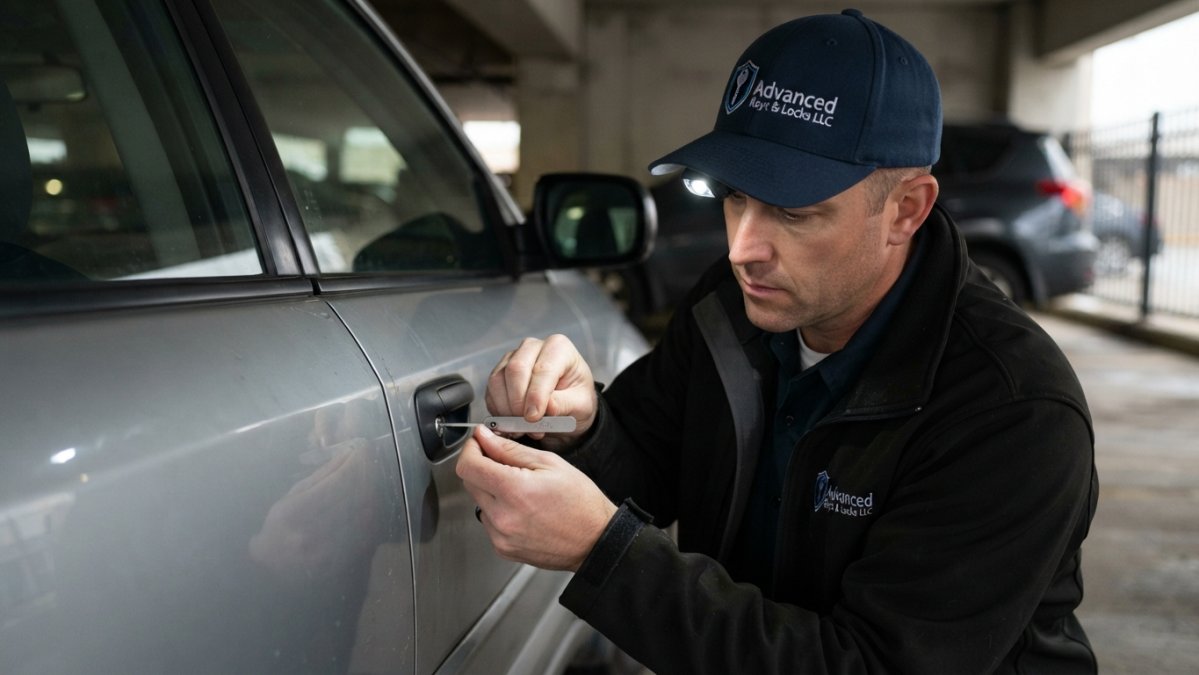
The most common mistake is angling the tweezers. Sideways pressure bends the fragment against the pins and jams it tighter. Pull straight, every time.
Pliers, Extractors, and Other Broken Key Extraction Tool Options
When tweezers cannot get a grip, move up to a stronger broken key extraction tool. Each suits a different situation.
Needle-nose pliers work well on a fragment with a solid lip of metal showing.
A broken key extractor is a slim steel tool with fine hooks or barbs at the tip. Slide it in beside the fragment, twist gently to catch the key's edge, and pull.
A quick comparison:
- Tweezers: best for fragments sticking out, low force, high precision.
- Needle-nose pliers: best for a solid grab point with room to work.
- Broken key extractor: best for flush or slightly recessed fragments.
Improvised Tools: Thin Blades, Hooks, and Coping Saw Blades
No extractor on hand? A few household items can work if chosen carefully. The goal is always the same: catch an edge of the fragment and pull it straight out.
- Coping saw blade: thin, flexible, and toothed. Slide it in beside the fragment, turn it so the teeth catch, and pull gently.
- Fish hook: a small hook, barb flattened or filed down, can catch the notch on a key's edge.
- Thin blade: a craft knife blade or a slim metal strip can wedge against the fragment's side and lever it forward, never deeper.
Avoid anything thick, blunt, or likely to snap inside the lock. A bent paper clip bends too easily and can leave its own debris in the keyway.
Matching the Method to the Lock Type and Fragment Position
Different locks demand different care: what works on a deadbolt can damage a car ignition or a smart lock. Match your approach to the hardware, then use fragment position to pick the tool.
Start with the mechanism, not the label
Most residential door locks are pin-tumbler cylinders: a plug turns inside a shell, with spring-loaded pins at the shear line. A broken key here usually rests on the pins or wedges at the shear line.
Wafer locks (cabinets, desk drawers, some vehicle doors) use flat wafers instead of pins. They tolerate slightly more side pressure but jam easily if the fragment is cocked. Disc-detainer locks (some vehicle ignitions, high-security padlocks) have no pin stack to catch a hook, so a fine-barbed extractor is usually the only DIY option.
Decision path by lock type
Door locks and deadbolts (pin-tumbler). The most forgiving category: tweezers, pliers, and extractors all work, and the cylinder is easy to reach.
Knob and lever locksets. The cylinder sits in a housing with less clearance than a deadbolt.
Smart locks and electronic locks. The keyway is often a backup entry point with electronics close behind it.
Padlocks. Usually simple.
Cabinet, desk, and furniture locks. Wafer or pin mechanisms with short keyways; tweezers usually reach a protruding fragment.
What to do when the lock is under tension
If the key snapped mid-turn, the cylinder may be loaded against the pins. Turn the handle or keyway back slightly to release pressure before pulling. A fragment under tension will not slide out no matter how hard you pull, and continued force is how pins get bent.
When to Call a Locksmith for a Broken Key
Some breaks are not a DIY job. Knowing when to stop protects both the lock and your wallet.
Call a locksmith when:
- The fragment is lodged deep inside the lock cylinder.
- The key snapped in a car ignition or a smart lock.
- You have tried two methods with no movement.
A certified locksmith has the right extraction tools and can remove the fragment without damaging the cylinder, then rekey or replace it on the spot if needed.
The honest rule: if you have spent more than ten minutes and the fragment has not moved, stop.
After Removal: Checks, Repairs, and Preventing the Next Break
Once the fragment is out, do not just shut the door. The lock needs a quick inspection and your key habits a second look, the step most guides skip, and where repeat breakage is prevented.
Inspect the cylinder before you trust it
- Insert your spare key and turn it through the full range. It should move smoothly with light pressure.
- Look inside the keyway with a flashlight for metal shavings, bits of the old key, or a bent pin leaf.
- Test the lock several times, including a full lock-and-unlock cycle with the door open.
If the key feels gritty or catches, the cylinder may need cleaning or a locksmith's inspection, a jammed pin now becomes a stuck key later. Do not spray lubricant into a keyway with debris; blow or vacuum it out first, then apply a dry lubricant made for locks.
Repair or replace: how to decide
A broken key is a symptom. The question is whether the cylinder is the cause.
- Replace the cylinder if the key binds at the same point every time, if the lock is old and has never been serviced, or if the fragment bent a pin on the way out. A standard residential pin-tumbler cylinder is inexpensive and swapping it is faster than diagnosing a damaged pin stack.
- Rekey instead of replace if the hardware is sound but you want new keys, or if you cannot verify who else has a key to the door.
- Clean and lubricate if the lock turns freely but feels dry or dusty. Use a dry-film or graphite lubricant designed for locks, not general-purpose oil, which attracts dirt and gums up pins over time.
Why keys break, and how to stop the next one
Most keys snap for predictable reasons. Address the cause or the replacement will break too.
- Worn keys. A key copied many times loses cut depth and rocks in the keyway, concentrating stress at the bow. Compare a suspect key against a fresh cut; if the cuts look rounded or shallow, replace it.
- Bent keys. A key that has been sat on or twisted is already fatigued. Straightening it weakens it further. Retire bent keys.
- Stiff locks. A lock that needs a jiggle or extra force is telling you the pins are dry, dirty, or misaligned. Fix the lock, not the key.
Keep a spare key stored outside the lock and off the main ring, and replace worn or bent keys before they fail. For homeowners and property managers, a locksmith can rekey, replace cylinders, and upgrade hardware with certified, insured technicians. Get a quote.
Frequently Asked Questions
How do you get a broken key out of a lock?
Start by checking how much of the broken key is visible. If a fragment sticks out, grip it with needle-nose pliers or tweezers and pull straight out, never at an angle. If it sits flush or inside the keyway, use a broken key extractor tool or a thin hook to catch the teeth and pull it toward you. Avoid pushing the fragment deeper. If it will not budge after a few careful attempts, stop and call a locksmith rather than risk damaging the lock cylinder.
Can I use tweezers to get a broken key out?
Tweezers work well when part of the broken key is sticking out of the keyway. Use fine-tipped or needle-nose tweezers, grip the exposed edge firmly, and pull straight out with steady pressure. Avoid twisting or wiggling, which can snap the fragment further or scratch the lock cylinder. If the fragment is flush with the lock face or lodged inside, tweezers usually cannot reach it, and a broken key extraction tool or thin hook is the better option.
What should I avoid when a key breaks in a lock?
Do not push the fragment deeper, and never force the lock to turn with the broken piece inside. Avoid superglue, excessive lubricant on a jammed fragment, and improvised tools that are thicker than the keyway, since these can damage the lock cylinder and turn a simple extraction into a full replacement. If the door is locked and you are outside, do not keep cycling the handle. Stop, assess the fragment position, and choose a method that pulls the key straight out.
When should I call a locksmith for a broken key?
Call a locksmith when the fragment is lodged deep inside the lock cylinder, when the lock is under tension or will not release the piece, when your attempts start scratching or bending the keyway, or when you need immediate door access. A locksmith has a broken key extraction tool kit and can remove the fragment without damaging the lock. If the lock is a high-security or commercial cylinder, professional extraction is usually the safer and cheaper path than a replacement.